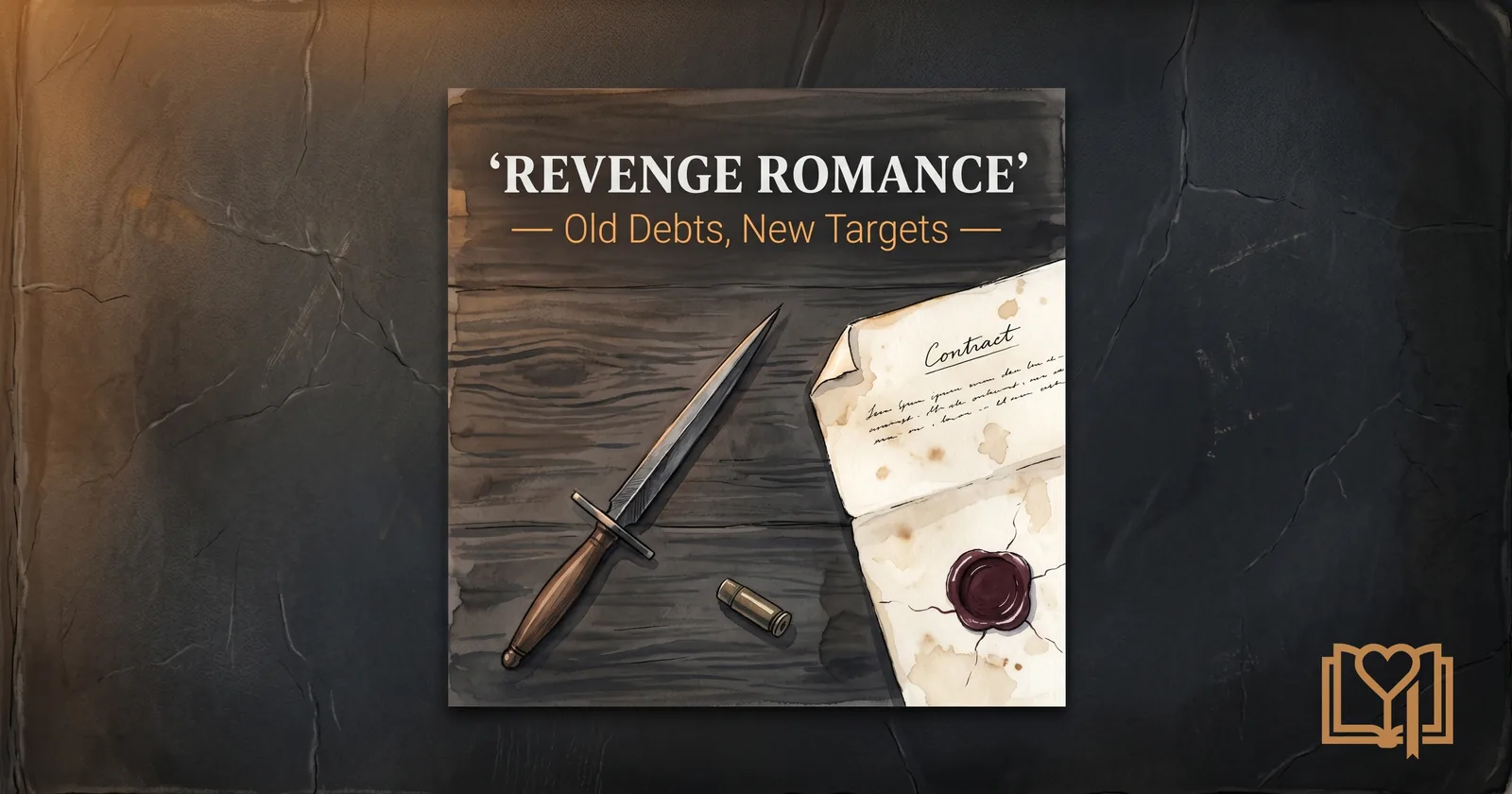
What Is Revenge Romance, Really?
What revenge romance actually is — how it splits from dark romance, the four setups it keeps running, and where to start reading the genre.
There's a specific moment, three or four chapters into a good revenge romance, when the reader realizes the hero across the table hasn't introduced himself so much as announced a verdict. The heroine has been moved into position by people she didn't know were planning her future. The plot started years before the book did. That moment — the rearrangement of the past, made suddenly visible — is the genre's whole machinery, compressed into a scene.
This is a working definition of revenge romance, written from our editorial side of the genre. It's not the BookTok shorthand, and it isn't the bookstore-shelf marketing copy. It's an attempt to draw the line where the genre actually starts.
What revenge romance actually is
Revenge romance is, broadly, a subgenre defined by its plot engine. A character — usually the hero, often both leads — is pursuing payback for an old wrong. The love story develops out of, around, and eventually in spite of that pursuit. The genre's central question is not whether the leads will get together; it's whether the revenge plan survives them getting together, and what gets left standing after it does.
That's the definition at its narrowest. The tonal range that sits on top of it is wide. A revenge romance can be a contemporary thriller, a mafia dynasty epic, a gothic-inflected suspense, or a billionaire-corporate boardroom drama. What ties them together is the plot's shape: someone is owed something, the road to collecting goes through the love interest, and by the end the math of the debt has changed.
Revenge romance vs dark romance
The two genres get conflated constantly, and the conflation hides what each one is actually doing. Dark romance is defined by tone — morally grey heroes, content that doesn't sand its edges, a willingness to sit with discomfort. Revenge romance is defined by plot mechanics. The overlap is enormous; the underlying machinery is different.
You can write a revenge romance that's barely dark — a Regency widow methodically dismantling the family that ruined her, played with wit rather than violence. You can write a dark romance with no revenge in it at all — a stalker fixation, a forced marriage, a captivity arc with no inciting grievance. The strongest titles in our catalog tend to be both, because the structures reinforce each other. But the categories themselves are separate, and treating them as one flattens what each one actually does.
Where it came from
The genealogy runs back further than the contemporary romance section suggests. The Count of Monte Cristo is a revenge romance with the romance attenuated; Wuthering Heights is a revenge romance with the romance corrupted; the entire Gothic tradition is built on inherited grievance, dynastic harm, and women who walk back into rooms they were meant to disappear from. The current wave didn't invent the plot. What it did was strip away the apologetic framing — the suggestion that the heroine should be horrified by the hero's methods, the requirement that the revenge be morally laundered before the kiss.
The BookTok-era revenge romance lets the plan be the plan. The heroine is allowed to find the man hunting her father interesting before she finds him terrifying. The hero is allowed to want her without losing the vendetta. That refusal to pre-soften the material is what reads as new, even though the trope itself is old.
The four setups it keeps running
Inside the genre, the same handful of inciting situations recur. Recognizing them is the difference between picking your next read at random and picking it for the specific shape you're in the mood for.
The collected debt. A parent or grandparent owed something to someone dangerous, and the heroine is what's left to collect on. This is the dominant setup of contemporary mafia revenge romance — the heroine inherits a debt she didn't sign and meets the man who's come to make sure it's paid. The genre's pleasure here is watching her refuse to be a transaction.
The framed daughter. The hero has a grievance against the heroine's family and decides she's the access point. Emily McIntire's Hooked is the BookTok-era textbook example — we walk through five of our titles that run this exact setup in a separate post. The shape goes back at least as far as Gothic novels of inheritance; the reader pleasure is the slow realization, by both leads, that the plan was always too tidy.
The wronged heroine. The revenge belongs to her. She returns to the town that ruined her, infiltrates the company that destroyed her father, or takes a job specifically to investigate the man she suspects. This is the harder setup to pull off — the hero has to be more than a target, and the genre's weak versions struggle here — but when it works it's the most satisfying configuration the genre has.
The mutual grudge. Both leads have a reason to want each other ruined, the plans collide, and the romance happens inside the wreckage. The mutual-grudge setup tends to read as the most thrillery — it's the closest the genre gets to a heist book — and it rewards readers who like watching two competent people read each other in real time.
Most of the books in our revenge romance shelf fall into one or two of these four. Knowing which setup a title runs gives you a quick way to predict whether it's the read you want tonight.
What it isn't
Revenge romance isn't a license to skip character work. The plots land because the grievance is built, the plan is plausible, and the heroine's pull toward the man executing it makes sense given who she is. The weak versions of the genre stop at he wants revenge and she's hot, which doesn't carry a novel.
It also isn't a substitute for the romance. The genre's HEA rule still applies — the vengeance arc can resolve cleanly or messily, but the two leads end up together. A revenge plot without a working love story underneath it is a thriller wearing the wrong cover.
Where to start with revenge romance
These three give a working introduction to the genre's shape, executed at different intensities. Read them in any order.
№ 01
The Cross Heir’s Contract
A clean entry point — old debt, contract collection, mafia heir reclaiming what was promised. Every move the genre depends on, executed without excess.
Read on Great Novels →This is the collected debt setup from the section above, written cleanly. Vivian's ten-year disappearance is doing the genre's main structural work — the reader watches her old life arrive in her lobby in the form of a man and a signet ring, and the rest of the book is what she does with that arrival. Read this first if you want to see the genre's wiring before you watch authors deviate from it.
№ 02
Owned by His Guilt
For when you want the sharper end. The hero claims the heroine as penance for her father's debt; the heroine spends the second half running her own plot. Two revenge arcs under one roof.
Read on Great Novels →The reason this one belongs after The Cross Heir's Contract is that the second half breaks the template. Most contemporary revenge romances let the hero keep the active role until the climax; this one hands the plot over to Kayla halfway through, and the back half is closer to Gone Girl than to a standard mafia title. The rare execution of the mutual grudge setup, contained inside a captivity narrative.
№ 03
Nurse of the Night
The flipped version. The heroine takes a job specifically to investigate the billionaire she suspects of harming her best friend. Proof the genre's machinery works in either direction.
Read on Great Novels →Save this one for after the first two — it's the wronged heroine setup, and it reads differently once you've watched the men run the same machinery first. Elena's investigation is colder, more deliberate, less reactive than the typical FMC arc, and the romance has to fit itself around her plan rather than the other way around. The genre's most demanding configuration when it works.
Find your next obsession
Hundreds of serialized novels. Read free, one chapter at a time.
FAQ