The email lands in my inbox at 7:42 a.m., right between a rejection from a mid-tier journal and a reminder that the departmental coffee machine is "for faculty use only."
Subject: URGENT: Academic Integrity Review – Mercer / Rowan
For a second I honestly think it's spam. The combination of our names looks wrong, like a simulation glitch.
Then my eye catches the sender.
Professor Malcolm Wells.
My stomach does that slow, nauseous tilt I associate with roller coasters and conference Q&As. I click.
Ava,
We require your presence at an emergency review meeting at 9:00 a.m. regarding concerns raised about your recent project (IRB #C-4739). Eli Rowan has also been summoned. This is a confidential matter.
Attendance is mandatory.
– M. Wells
I stare at the screen until the text goes slightly double.
"No," I say out loud to my empty office. My voice sounds too calm. "Absolutely not."
The monitor hums back at me, unhelpfully objective.
A plagiarism review.
Concern.
Eli Rowan.
My mouse hand twitches, enough to send a tremor through the stack of printed drafts beside the keyboard. I spent the last three months buried in this project, sleeping under my desk twice, eating instant noodles over a fMRI console. I know every line of code, every footnote.
If anyone plagiarized, it wasn't me.
I check the time—7:45. My first instinct is to forward the email to Dr. Carver, with a twelve-paragraph breakdown of why this is insane. My second instinct is to throw my laptop out the window.
I do neither. Instead, I open my project folder for IRB #C-4739 and scroll through file names: preprocessing scripts, anonymized datasets, pilot study logs. They look suddenly flimsy, like props instead of the spine of my life.
"It's fine," I tell myself, because no one else will. "Honesty is falsifiable. They can test it."
The joke falls flat even in my own head.
By 8:55 I'm outside the small conference room on the third floor, the one only used for dissertation defenses and interventions. The frosted glass panel is supposed to be soundproof, but I can hear a low murmur inside—Wells' smooth baritone and the sharper, bureaucratic clip of Dean Ellery.
Of course.
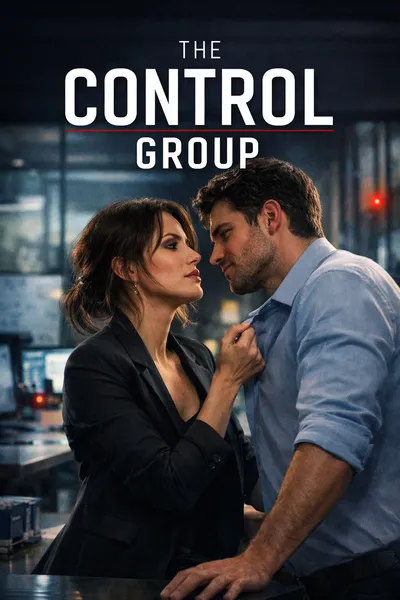
I adjust my grip on my notebook, then realize my knuckles have gone white and loosen my fingers. The corridor smells faintly of burned coffee and dry-erase markers. My reflection in the glass door looks like an undercaffeinated ghost: dark hair scraped into what I'm generously calling a bun, black turtleneck, the same noise-canceling headphones hanging around my neck like a stress necklace.
Behind me, footsteps.
Everything in me wants to ignore them. I have a law about this.
I formulated it my second semester, after he showed up late to Wells' seminar with a smile and no notes, improvised an entire critique of a paper I'd been dissecting for weeks, and still managed to make Wells laugh.
The Law of Rowan: Do not look directly at Eli. Do not think about Eli. And under no circumstances, ever, talk to Eli.
My body, traitor that it is, starts to turn anyway.
"Morning, Mercer."
Of course. Of course he sounds like he slept eight hours and did yoga.
I look at him because apparently self-preservation is a myth.
He's in a navy button-down with the sleeves rolled to his elbows, messenger bag slung cross-body, hair slightly damp and pushed back like he ran a hand through it on his way over. There's a coffee cup balanced in one hand and an edge in his jaw that doesn't match his voice.
"Rowan," I say, keeping my own voice flat enough to iron shirts on. "You're in my email."
One of his eyebrows lifts. "That's a new line."
"Not a line. A complaint."
His smile is brief, not quite reaching his eyes. "So you got it too. The summons."
"What did you do?" I ask.
The fact that the question tumbles out without a filter annoys me. But not as much as the way he flinches, almost invisible, the curve of his mouth tightening before he shrugs.
"Apparently," he says, "I commit plagiarism in my sleep now."
My heart knocks once, hard. "They're accusing you too."
He blinks. "You didn't know?"
"The email said... concerns about my project." I hear the thinness in my voice and hate it. "And that you were being summoned. I assumed they wanted you as—" I stop.
As a witness. As the control.
His gaze sharpens. I see the thought hit him too.
"Wow," he says quietly. "That's—no offense—cold, even for them."
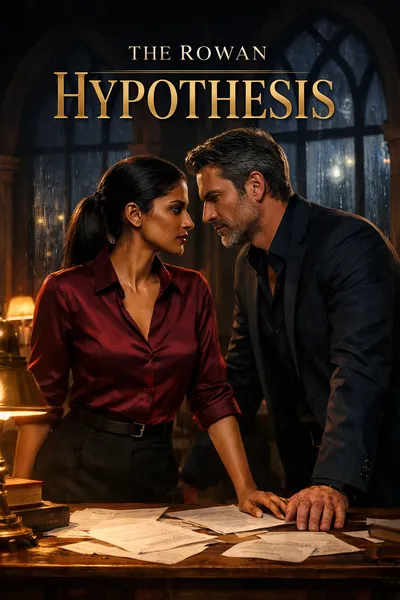
The door opens before I can respond. Professor Wells fills the doorway like he's been staged there for effect—tweed jacket, silk tie, silver hair perfectly in place. Behind his glasses, his eyes land first on me, then on Eli, and his smile appears, polished and paternal.
"Ava. Eli. Good, you're early. Come in."
The room is smaller than I remember from other people's defenses. Oval table, eight chairs, walls lined with framed photos of past cohorts. The air conditioning is turned up too high; goosebumps lift on my forearms.
Dean Ellery sits at the far end of the table, iPad laid out in front of him like a shield. He nods, expression neutral in that practiced administrative way that says: I have already chosen the path of least resistance.
"Please," Wells says, gesturing. "Sit."
I take the chair directly opposite the door, back straight, notebook open in front of me. Eli drops into the seat one over from mine, leaving a single empty chair between us like a demilitarized zone.
Wells remains standing for a moment, hands on the back of a chair, surveying us.
"First," he says, "I want to assure both of you that this is a fact-finding conversation. No conclusions have been drawn." His glance at Ellery is swift and unreadable. "However, the issues raised are serious and must be handled with discretion."
Serious. Discretion. My palms start to sweat.
Ellery taps something on his tablet. "Dr. Mercer, Dr. Rowan," he says, formal, "as you're aware, you've both recently submitted manuscripts derived from projects conducted under this department's purview. Independent projects, but with overlapping methodologies and datasets." He swipes, then rotates the iPad so it's angled toward us. I catch a glimpse of a PDF—my paper—and another title beneath it that makes my spine tighten.
The Control of Attentional Drift in High-Stakes Cognitive Tasks.
By Elias Rowan.
It's like a funhouse mirror of my own title.
"Overlapping," I repeat. "How overlapping?"
"Uncomfortably," Wells says softly.
He pushes a packet across the table. I flip it open. Side-by-side excerpts: paragraphs nearly identical in structure, similar phrases, mirrored references. Figures that look disturbingly like mine, down to the color scheme.
My throat goes dry.
"That's—" I force my voice to work. "That's impossible. I wrote my manuscript in my office. The data is stored on the lab server under my login."
"Same," Eli says. His chair creaks as he leans forward, arms braced on the table. "Different office, but you get the idea. I pulled my own data from the behavioral lab. Different time blocks. Different subjects."
"And yet," Ellery says, almost apologetic, "our plagiarism-detection software flags an overlap score of eighty-seven percent between your manuscripts. The odds of that occurring independently, even accounting for shared paradigms, are vanishingly low."
I hear the words but they feel like they're aimed an inch to my left.
Eighty-seven percent.
My vision tightens at the edges.
"We checked,» Wells says, "timestamps, edit histories, proposal documents. You both proposed similar hypotheses months ago. That, on its own, is not unheard of in a competitive field." His gaze warms on me, familiar and suddenly cloying. "You've both trained under the same intellectual lineage. Shared ideas are inevitable." He lets the praise hang there for a second before slicing it. "But this degree of textual similarity cannot be ignored."
"You think we copied each other," I say.
"Or," Ellery says, "that someone shared material inappropriately."
My jaw clenches. "I didn't share my work." I turn, finally, fully, to Eli. "And I didn't copy you."
He meets my stare. For once, there is nothing easy in his expression—no smirk, no deflecting charm. Just anger held very, very carefully in place.
"Funny," he says. "I was about to say the same thing to you."
The room goes quiet. Wells watches us like we're an experiment.
"No one's accusing anyone yet," he lies. "We are, however, obligated to investigate. The journal has been notified of possible misconduct and has paused the review process."
Every organ in my body seems to rearrange. "Paused," I repeat.
Paused is the nice word. The word before blacklisted.
"Professor," Eli starts, a thread of strain in his voice now, "I've been in your lab for six years. Do you really think I'd risk—"
"Integrity," Wells cuts in smoothly, "is not a matter of tenure, Eli. It's a matter of process. Which is why we are proposing a solution that serves both fairness and transparency."
I don't like the way he says proposing. As if this is a compromise and not a sentence.
"Given the overlap," Ellery says, picking up the script again, "and the confidential nature of this matter, we cannot allow either of your current projects to move forward until we determine what has happened. However, punishing innovation is not in the university's interest." He gives us a thin smile. "Thus, Professor Wells has suggested an integrity protocol."
Wells steeples his fingers. "A controlled collaboration," he says. "You will design and execute a new study together, from scratch, under supervision. Full data transparency. Shared authorship. Every meeting logged, every dataset mirrored."
For a moment I think I've misheard him.
"Together," I say.
Eli laughs, a short, incredulous sound. "With all due respect, Professor, that is the worst idea I've heard since the mandatory wellness seminar."
"It's not optional," Wells says, the softness gone from his voice. "Consider it an integrity experiment. A way to demonstrate that, when placed under observation, both of you can produce original, rigorous work."
"And if we refuse?" I ask.
Ellery hesitates. Wells doesn't.
"Then," he says, "the misconduct investigation proceeds without the mitigating evidence of your cooperation. And the journals will likely interpret noncooperation as tacit admission."
My chest tightens, slow and brutal.
I worked too hard for my name to end with an asterisk.
"Timeline?" I ask, because if I focus on logistics I won't impress a chair impression into this table.
Wells' mouth twitches, pleased. "We'd like a full proposal within two weeks. Data collection immediately thereafter. The department will allocate you a dedicated lab space and schedule."
"Dedicated," Eli echoes. "As in—"
"You'll share the space," Wells confirms. "For the duration. You'll also attend weekly check-ins with me and Dr. Carver, and you'll submit your logs to the dean's office."
It's a cage, dressed up as an opportunity.
I feel Eli's gaze on me, sideways. I don't look back.
"This is absurd," I say. "You can't seriously believe we magically wrote the same paper and the only solution is forced collaboration." My laugh is sharp. "What about checking the server logs? The backup drives? Access histories?"
"We will," Wells says smoothly. "IT has already been instructed to perform a cursory audit. But these things take time. In the meantime, perception matters. We must be seen to be proactive."
Translation: donors are twitchy, and we're expendable but useful.
"Look," Eli says, exhaling. I realize with a small shock that his hands are shaking slightly where they rest on the table. "I don't know how our work ended up looking like that. I don't know who benefits from that. But I do know I didn't cheat my way into this room. And I highly doubt Ava did either." His eyes flicker to mine, quick. "As much as she terrifies me."
It's an attempt at humor, and under other circumstances I would skewer it. Now it lands somewhere lower, warmer, unsettling.
I clear my throat. "I'm not thrilled about trusting my reputation to someone whose idea of version control is naming files 'Final_Final_2'," I say, because if I don't push back I'll start screaming. "But I'm less thrilled about being quietly buried as a cautionary tale." I look straight at Wells. "So I want conditions."
He tilts his head. "Such as?"
"Full access to the audit results," I say. "Not just whatever summary you decide to grace us with. Copies of our own data, in our own encrypted drives. And Dr. Carver is primary methodological supervisor, not you. You're conflict of interest personified."
Ellery's brows shoot up. Wells' expression doesn't change, but the temperature in the room drops a few degrees.
"Ava," he says in that gentle-scolding tone I used to mistake for concern, "I understand this is distressing, but—"
"It's reasonable," Eli cuts in, surprising me. "If we're doing this circus, we want a ticket to the backstage." He glances at the dean. "Otherwise it looks less like an integrity exercise and more like a convenient way to park us somewhere out of sight."
For a moment, something like irritation flickers over Ellery's face. Then it's gone.
"Transparency is in everyone's interest," he says. "We'll loop IT into providing you with non-sensitive portions of the audit. As for supervision—" He looks to Wells.
Wells' smile has too many teeth. "Of course Dr. Carver will be involved," he says. "I wouldn't dream of excluding her."
Which is not the same as conceding anything.
But it's on the record now. And that, at least, is data.
He straightens. "You'll receive the formal protocol by this afternoon. I'd suggest you start thinking about paradigms. Something robust but feasible given the time pressure." His gaze lingers on me. "I trust your creativity. Both of you."
The meeting dissolves after that into procedural noise: forms, policies, the number of cameras that will be mounted in the lab. I answer mechanically, muscles locked, while my brain sprints ahead.
Cameras. Shared logins. No unsupervised time in the lab. Every keystroke recorded.
Wells escorts Ellery out with a hand on his elbow, their voices dropping to a murmur as they walk down the hallway. The door clicks shut behind them.
Silence.
I realize I'm still gripping my pen like a weapon.
"Well," Eli says finally. "This is not how I imagined our first coauthored paper."
I shut my notebook. The thud is louder than it needs to be. "I didn't imagine it at all."
"You never thought we'd collaborate?" he asks, sounding genuinely curious.
"No." I stand, sliding my chair back. The room feels suddenly too small, the walls too close. "I thought I would spend the rest of my career disproving your hypotheses from a safe distance."
He huffs out a laugh. "Romantic."
I move toward the door. "Don't flatter yourself. It wasn't about you."
"Liar," he says lightly.
I freeze with my hand on the doorknob.
It's nothing. A joke. A word people toss around when someone claims they don't like chocolate.
But there's something in the way he says it, in the way the air shifts between us—like he doesn't quite believe his own casual tone.
I look back at him.
"Listen, Rowan," I say. "Whatever this is—" I gesture vaguely at the table, the files, the invisible, humming cameras already being imagined into that future lab—"—we're not friends. We're not allies. We're two separate variables being shoved into the same ugly experiment."
He leans back in his chair, studying me. "Variables interact," he says softly. "That's sort of the point."
"Not if one of them refuses," I shoot back.
"That's not how statistics work."
"It's how I work."
He stands then, slow, pushing his chair in. For the first time, he's close enough that I can see the faint shadows under his eyes, the tightness around his mouth. His shirt is slightly creased at one shoulder where his bag strap cut in. The golden boy looks a little tarnished.
"For what it's worth," he says, "if someone is screwing with us, I'm not okay with being the easy suspect."
"You're not the easy suspect," I say before I can stop myself. "You're the golden child."
His smile is quick and bitter. "You'd be surprised how fast that changes when donors smell scandal."
I file that tone away: something I haven't heard from him before.
"We should at least agree on one thing," he continues. "Baseline conditions. If we're going to be locked in a box together, we need to know if the cat is alive."
"You are not allowed to reference Schrödinger in a conversation about my career," I say. "It's tacky."
A corner of his mouth lifts. "Fine. New metaphor later. Point is—" He sobers. "We trust the data more than we distrust each other."
I actually laugh at that, sharp and disbelieving. "That's your proposal?"
"It's the only one that doesn't end with both of us out of a job," he says.
Trust the data more than I distrust him.
My instinct is to say no. To cling to the safety of my own solitude, my own rigor. To assume that, under pressure, everyone chooses themselves.
But the image of those side-by-side pages flashes behind my eyes again, and underneath the fury is something colder: fear.
If someone can make our work look like that once, they can do it again.
"Baseline," I echo, slowly. "We look at everything. Server logs. Access times. Lab sign-ins. We document every weird blip."
"Together," he says.
The word lands between us like a challenge.
"Together," I repeat, because survival beats pride. For now.
He nods once, and for a heartbeat there's something like relief in his face. It makes my chest ache in a way I do not have time to examine.
I open the door. The corridor looks the same—same flickering fluorescent light, same scuffed linoleum—but it feels different now, like the beginning of someone else's experiment.
"I'll email you," Eli says behind me. "About paradigms."
"Don't," I say over my shoulder. "We'll schedule on the shared calendar."
"Mercer." His voice stops me again, softer this time.
I don't turn.
"Whatever they think we did," he says, "I'm going to prove them wrong. And if that means spending the next few months trapped in a lab with you, arguing about error bars..." I hear the faintest smile in his words. "I can live with that."
I stare at the hallway clock until the minute hand clicks forward.
"We'll see," I say.
And then I walk away before he can say anything else that might make the ground under my carefully controlled life shift even more.
Behind me, in the quiet I leave, I can almost feel his gaze—steady, unreadable.
It feels like warmth pretending to be distance.
Later, when the IT email pings and the subject line reads Preliminary Audit Findings – Access Irregularities Detected, I'm still not sure which unnerves me more: the possibility that someone has their hands in my data.
Or the fact that for the first time in years, my first instinct is to forward the message to Eli.