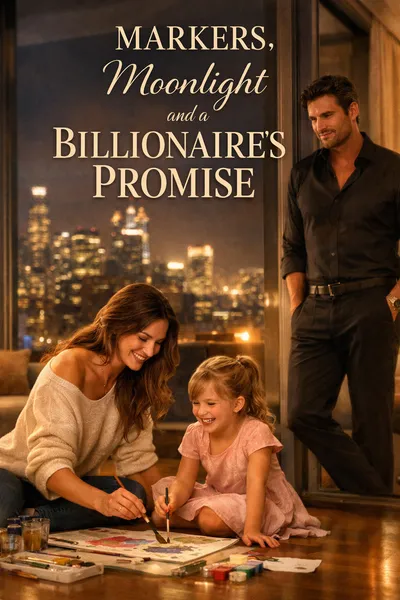
By the time the copier coughed out its last, streaky flyer, my classroom already smelled like panic and dried markers.
The panic was mine. The markers, thankfully, were the kids’.
“Miss Mila, my unicorn needs more sparkles!” Mia announced, thrusting a purple-stained page at me.
“That unicorn is one shimmer away from blinding us all,” I said, forcing a smile as I dug in the communal glitter bin. “But I respect her commitment to extra.”
Mia giggled, and for a second the knot in my stomach loosened. This room—half peeling murals, half crooked smiles—was the only place where I felt like I wasn’t failing at something.
On the back counter, the stack of freshly printed flyers waited: SAVE OUR KIDS’ CENTER! with a grainy photo of last summer’s art show. My cheerful clip-art font did its best to pretend the center wasn’t two missed grants away from going dark.
“Okay, artists,” I called, dusting glitter off my hands, “ten minutes until clean-up. Then we hang posters like our lives depend on it.”
Technically, only my job depended on it. I wasn’t telling eight-year-olds that.
A chorus of groans rose, punctuated by the thump of a basketball from the gym down the hall and the distant buzz of the failing fluorescent lights. The whole building hummed with barely-contained exhaustion.
Harper appeared in my doorway like she’d been summoned by the word panic. Her messy bun sat at a defiant angle, and her lanyard was a tangle of keys and stress.
“Quick meeting,” she murmured. “Now, before you adopt another stray child or medium-sized raccoon.”
“In my defense, he needed help,” I said. “And he was very polite.”
“That raccoon stole your yogurt.”
“Boundaries are a journey,” I said under my breath, snagging a wipe to clean glitter off my forearms. “Guys, keep coloring. No glitter fights or I’ll make you all draw still lifes of broccoli.”
“Ew!” they chorused, which bought me at least five semi-quiet minutes.
In the hall, the air felt cooler, the noise from other rooms echoing off cinderblock walls. Posters of smiling kids overlapped notices about funding cuts. Harper leaned against the opposite wall, one sneaker braced behind her.
“Board meeting was brutal,” she said without preamble. “We lost the city supplemental grant. They’re… talking timelines.”
Her eyes, usually quick with sarcasm, were dull.
“How bad?” My voice came out thin.
“Bad, Mila. Unless a miracle donation falls from the sky, we’ve got maybe three months. Six if we cut staff.” She forced a crooked grin. “I volunteered my own burnout as tribute.”
“Absolutely not,” I snapped, then lowered my voice when a group of kids thundered past. “We’ll fundraise. The gala, the online campaign, I’ll sell my organs on Etsy—”
“Pretty sure that violates their terms of service.”
“I’ll make it work,” I insisted. “I always do.”
Harper’s gaze softened in that way I hated—concern edged with pity. “You don’t have to bleed for this place alone.”
But I did. Because this center was the one thing that had never left me. Not like my dad, not like the boy who said my art degree was ‘cute’ before he broke up with me over text.
“I’ll get those flyers up,” I said instead. “We’ll shake the neighborhood until someone with deep pockets notices.”
“As long as you don’t flirt with any billionaires,” she muttered. “They’re bad for your health.”
“Please. The closest I’ve gotten to a billionaire is watching a documentary about tax evasion.”
She snorted. “Just… don’t forget to ask for help if you need it, okay?”
I nodded, but the word no perched stubbornly on my tongue. Asking for help felt too much like admitting I wasn’t enough.
When I slipped back into my classroom, the first thing I saw was the back of a small girl crouched under my easel.
She was curled tight, dark hair falling over her face, skinny shoulders hunched. Her hands pressed over her ears. My kids hovered in a loose, uncertain circle around her.
“Miss Mila,” whispered Jamal, eyes wide, “she just came in and went… there.”
“Okay,” I murmured, my heartbeat stuttering. “Everyone back to your tables. Color quietly. This is a sneak-attack calm mission.”
They scattered with theatrical stealth, each one stealing glances over their shoulders.
I crouched next to the easel, feeling the old linoleum press through my jeans.
“Hey,” I said softly. “I’m Mila. This is my secret artist cave. You picked the best hiding spot.”
The girl didn’t move. Her breathing came shallow and fast, like a trapped bird.
Up close, I noticed the scuffed Mary Janes, the expensive-looking cardigan hanging off one bony shoulder. A pale wrist, bare where a watch might’ve been.
“I have it on good authority,” I went on, “that under this easel, nobody can make you do algebra or eat broccoli.”
A tiny snort escaped, so faint I almost missed it.
“My superpower is making very serious adults accidentally sit on glue,” I said. “What’s yours?”
Her fingers loosened a fraction over her ears. One eye peeked at me through her hair—hazel, ringed with red.
“I don’t… I don’t want to be here,” she whispered. “He made me.”
I had a hundred questions. Who was he? Where was here? Why did her voice sound like a scraped knee? But I had learned that with kids like this, the fastest way forward was sideways.
“Yeah, adults are the worst,” I agreed. “Always making you go to places that smell like feet.” I wrinkled my nose. “Good news: this room smells like markers and glitter glue. Very elite scent profile.”
She blinked, wary and curious both.
“What if,” I suggested, “you stay exactly where you are, and I slide you a marker. If you hate it after ten minutes, you can crawl back out and I’ll pretend I never saw you. Deal?”
The tiniest nod.
I held out a marker under the easel, cap-first so she could choose. Her hand darted out, surprisingly fast, and snatched the blue from my fingers.
“Excellent choice,” I said. “Blue is the official color of secret caves.”
Her mouth twitched, then disappeared again behind her hair as she bent over the floor. I slid a piece of cardstock under there like a peace treaty.
“Miss Mila?” Mia stage-whispered. “Can we draw under the table too?”
“Nice try,” I said. “Chairs are for butts, not for hiding. New rule.”
A few of them giggled and returned to their pages. The room’s anxious buzz settled into a quieter hum. I stayed crouched, my knees protesting but my chest loosening as the girl’s breathing slowed.
Footsteps pounded down the hall, growing louder, purposeful. The good kind of purposeful or the uh-oh kind? I couldn’t tell until a tall man filled the doorway, one hand braced on the frame like he needed it to stay upright.
He wore a navy button-down with the sleeves rolled up, dark jeans, and an expression like the world had just asked him for one favor too many. His hair was slightly mussed, like he’d been dragging his fingers through it. He carried a leather messenger bag and an air of I don’t have time for this.
He also had the kind of face that made my brain short-circuit for a beat.
Strong jaw, mouth set a little too tight, eyes sweeping the room until they landed on me and the easel. Something like relief flashed there, quickly chased by irritation.
“Lily,” he said, voice low but firm. “You can’t just run off like that.”
Her shoulders stiffened under the easel.
I straightened slowly, knees cracking, and dusted my hands on my paint-splattered apron.
“You must be ‘he,’” I said.
His brows shot up. “I’m sorry?”
“I’m guessing you brought her,” I nodded toward the easel, “and she very politely informed me that she did not want to be here.”
He exhaled through his nose, a muscle ticking near his temple. “That sounds about right.”
He stepped into the room, gaze flicking over the chaotic tables, the crooked paper chains, the faded mural of a cartoon city skyline I’d painted my first year here. His jaw eased a fraction, like he’d been expecting prison walls instead of finger-paint.
“I’m Oliver Hayes,” he said. “My niece is… under your furniture.”
“Niece has excellent taste in hiding spots,” I said. “I’m Mila. Art wrangler.” I stuck out a hand.
He hesitated, then took it. His palm was warm and dry, his grip firm but not crushing. For a second, the room shrank to the feel of his fingers around mine, the brief brush of skin that sent an inexplicable little spark up my arm.
I pulled back, tucking my hand against the edge of a table.
“Lily came in here on her own,” I said. “She’s safe. She’s drawing.”
“She’s supposed to be in the rec room.” He scanned the underside of the easel like he could drag her out by sheer will. “This is our first time here. I looked away for thirty seconds and she vanished.”
His voice cracked, just barely, on the last word.
There it was—the real thing under all that controlled exhaustion. Not annoyance. Fear.
“She found the art room,” I said gently. “Trust me, that’s a solid life choice.”
As if on cue, Lily’s voice floated out, small but clearer. “Uncle Ollie?”
He crouched, big frame folding in on itself with surprising grace.
“I’m here, Lilypad,” he said, the nickname softening everything about him. “You can’t run off without telling me, okay? I—” He stopped, swallowed. “I was scared.”
Silence stretched. A blue marker rolled out from under the easel, leaving a streak across the floor.
“Do I have to go to the big room?” she asked, not moving.
He looked at me, helpless in a way he probably hated.
“We hang out in here after school,” I said, lowering my voice. “It’s quieter. You can… both stay, if you want.”
“I’m not exactly a crayons kind of guy,” he muttered.
“Markers,” I corrected automatically. “And there’s no entry exam. You just have to promise not to eat the glue.”
A reluctant huff of something like amusement escaped him.
“See?” I added. “Already passing.”
He stood slowly. I expected him to insist, to scoop her up and march her to the rec room like every other stressed-out guardian who’d walked through my door.
Instead, he rubbed a hand over the back of his neck and said, “If she wants to stay… is that okay? I don’t want to put her somewhere she’ll just hide.”
Wow. A man who listened instead of bulldozed. The bar was on the floor, but still.
“It’s more than okay,” I said. “We do creative chaos till five. You’re welcome to… hover.”
His lips twitched. “I have some emails to send.”
“Ah yes, the sacred work email posture,” I said. “We have a special chair for that.”
He glanced at the battered metal chair in the corner, then back at me. “You joke, but that looks better than half the conference rooms I’ve been in this week.”
He moved toward it, and as he did, he brushed past a drying rack of paintings. The corner of his bag snagged a clothespin, sending a storm of paper fluttering to the floor.
“Sorry,” he said immediately, bending to scoop them up.
He handled each painting like it was something fragile, not just wobbly stick figures and too-much-sky. He didn’t complain. He didn’t bark at a kid for bumping into him two seconds later. He just… existed in the chaos without trying to shove it into neat lines.
Interesting.
“Uncle Ollie?” Lily’s head emerged at last, hair staticky, cheeks streaked with blue where her hands must’ve rubbed her eyes. She clutched the cardstock like a shield.
He straightened so fast he almost hit his head on the easel.
“I’m right here,” he said.
She crawled out, staying low, eyes darting around the room. When they landed on me, her shoulders lowered a millimeter.
“Miss Mila says I can stay,” she announced, like issuing a decree.
“Does she now?” Oliver glanced at me, one brow raised.
“She does,” I said. “On one condition.”
Lily’s eyes widened. “What?”
“You have to show me what you drew in my secret artist cave. It’s the law.”
She hesitated, then turned the paper around.
My throat tightened. It was a house, lopsided but detailed—two floors, chimney, a swing set in the yard. In the window, three stick figures: a tall one, a smaller one, and an even smaller one clutching something blue.
“That’s me,” she said, tapping the tiniest figure. “That’s Uncle Ollie. That’s…” Her voice thinned. “That’s Mommy. But she’s… she’s in the sky now so she can’t come out.”
The words hit the air with the awkward finality of a door slamming on a storm.
I felt Oliver go still beside me without looking at him.
“That’s a beautiful drawing,” I managed. “I love your swing set.”
Her chin wobbled. “We don’t have a swing set.”
“Not yet,” I said, choosing light. “But if there were one, I bet it would look exactly like this. With the squeaky chains and everything.”
She sniffed, a tiny laugh escaping through snot and sorrow.
“I miss her,” she whispered.
“I know,” Oliver said hoarsely.
He dropped to one knee beside her. For a second, his hand hovered in the air like he wasn’t sure where to put it. Then he rested it gently on her back, tentative but steady.
“I miss her too,” he said. “Every day, Lilypad.”
She leaned back into him, the way kids do when they trust the arms behind them will hold. His shoulders sagged with the weight and the relief of it.
The room blurred for a moment. I busied myself with aligning a jar of brushes that didn’t need aligning.
“Hey,” I said after a beat, needing to shift the air. “We actually have swings here. Not as cool as yours, but they’re pretty high. After art, I’ll take you to them. Deal?”
She looked up at me from under her lashes. “Will you push me?”
“Absolutely. I have expert-level pushing skills. I can make you feel like you’re flying, but not the scary kind. Just the fun kind.”
Some of the tightness in her mouth eased. “Okay.”
“Cool.” I clapped once, light. “Then we better get serious about our art. We have, like, twenty minutes to make masterpieces.”
“Can I sit by you?” she asked.
“Of course. There’s a premium seat right next to my marker stash.”
She nodded gravely, then reached up without looking and wrapped her hand around Oliver’s fingers.
“Come too,” she said.
Something flickered across his face—surprise, then something rawer. He glanced at me again, like he needed permission.
“There’s enough marker real estate for everyone,” I said. “We don’t discriminate against grown-ups who color.”
“I have a reputation to maintain,” he muttered, but let her tug him toward the nearest table.
He ended up on a too-small chair, knees folded awkwardly, Lily pressed to his side as she chose colors. Up close like this, he looked younger than he had in the doorway. Tired, yes. But there were faint laugh lines at the corners of his eyes, like whoever he’d been before grief had known how to smile.
“Uncle Ollie, what color is the sky?” Lily asked.
“Blue?” he tried.
She frowned. “Miss Mila’s sky is purple.”
His gaze darted to the mural on the far wall, where my version of sunset bled into midnight.
“Then purple,” he said easily. “Obviously.”
My chest did a strange little flip.
As they bent over the paper together, I moved around the room, helping with smeared crayons and negotiating very serious disputes about unicorn horn colors. But my awareness kept circling back to table three, where the man who’d walked in stiff with control was now hunched over a sheet of paper, letting a grieving little girl color a purple sky over the outline of a crooked house.
By the time five o’clock crept up, Lily’s page was a riot of color—three stick figures holding hands under a violet dome. The third one was taller now. The smallest one had a blue dot in her hand.
“What’s that?” I asked, pointing.
She smiled, shy but proud. “It’s a marker. For Miss Mila. ‘Cause she has them all.”
My throat closed. “I’ll treasure it forever,” I said lightly.
The other kids began stuffing papers into backpacks. The low sun spilled through the cracked windows, turning dust into glitter. The day’s noise thinned into scattered goodbyes.
Oliver helped Lily gather her things, moving slower now, as if the room’s pace had infected him.
“Thank you,” he said quietly when most of the kids had gone. “For… not forcing her.”
“That’s kind of my whole thing,” I said. “We go at kid speed here.”
“Kid speed,” he repeated, tasting the words. “I’m… still figuring that out.”
I wiped a paint smudge from the table. “First time guardian?”
“First time… everything.” His jaw tightened. “Her mom was my sister. It’s been three months. I thought—” He cut himself off, shook his head. “Never mind.”
“You thought it would be easier by now,” I finished softly.
He looked at me sharply, then away. “Something like that.”
“Grief doesn’t do timelines,” I said. “It just… shows up with its suitcase and moves in for a while.”
He huffed, no humor in it. “That’s… accurate.”
Lily tugged his sleeve. “Can we come back tomorrow?”
His answer came with zero hesitation. “If Miss Mila says it’s okay.”
Heat bloomed under my skin at the casual way he handed me that power.
“Tomorrow we’re making cardboard cities,” I said. “There will be tape. It’s going to be intense.”
Lily’s eyes lit. “I wanna build a house like mine!”
“Perfect,” I said. “We’ll make it with extra-strong walls and a giant swing set.”
She nodded like we’d just signed a binding contract.
As they walked toward the door, she skipped half a step ahead, then spun around and darted back.
She flung her arms around my waist, fast and fierce. I froze for a second, then folded my hands lightly over her back, careful, like she was glass and wildfire both.
“Bye, Miss Mila,” she mumbled into my apron.
“Bye, Lily.” I kept my voice steady. “Same time tomorrow?”
She nodded against me, then let go, running back to Oliver, who watched us with an unreadable expression.
He lifted his hand in a small, almost awkward wave. “See you tomorrow, Mila.”
Hearing my name in his voice did something stupid to my chest.
“Tomorrow,” I echoed.
They left, the echo of their footsteps swallowed by the hallway. For a moment, the room felt too quiet, the late-afternoon light suddenly brittle.
I turned back to the stack of SAVE OUR KIDS’ CENTER flyers and sighed.
I still had no miracle, no billionaire, no plan beyond hustle and hope.
But I did have one new kid who’d chosen this room as her safe place.
As I straightened the flyers, blue ink smudged across the top one. A single word had been stamped there in slightly shaky letters, probably from marker-stained hands:
home.
I traced it with my fingertip, my pulse settling into something new—a mix of fear and the faintest flicker of something like possibility.
I didn’t know yet that the man who’d just walked out would be the one to offer me both the miracle and the mess I’d been secretly wishing for.
I only knew that tomorrow, at three o’clock, I’d be waiting by the door.
And that when Oliver Hayes came back, I was going to notice him. No matter how hard I pretended not to.