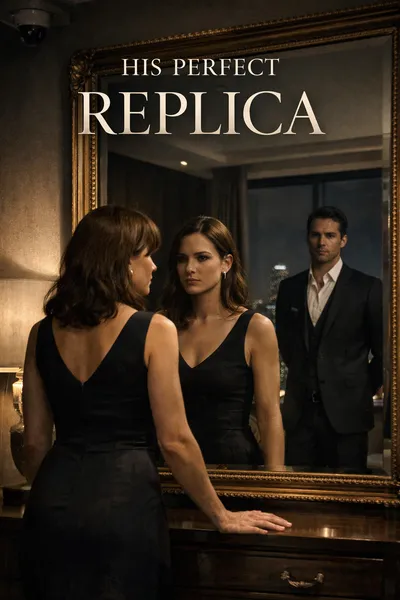
By the time he walked into my library, the storm had already started.
Not the one rattling the old windows—March rain needling sideways across the parking lot, sky the color of wet slate. That I could handle. The other one started when the door hissed open against its tired hydraulic and every sound in the reading room thinned, like the air didn't know what to do with him.
I looked up from the circled due date on a dog-eared romance novel and saw a stranger who did not belong in a small-town public library, let alone mine.
He wore the kind of suit I’d only seen on magazine covers left behind by commuters: dark as ink, precise as a threat. Rain jeweled on the shoulders of his overcoat before sliding down in clean, unforgiving lines. People like that were supposed to stay behind glass—on screens, in ads—not drip onto my scuffed linoleum.
He paused on the mat, as if giving the room a chance to understand it had been altered. A mother at the children’s table murmured something to her toddler and glanced over, eyes widening. Old Mr. Hanley pretended to read the newspaper and didn't turn a single page.
Then the stranger's attention found me behind the circulation desk.
My fingers tightened around the paperback. "Can I help you?" I managed. My voice sounded normal. That felt like an accomplishment.
He removed black leather gloves one finger at a time, folding them neatly. That small, unhurried motion told me everything I needed to know about him: he had time, because he took it from others.
"You’re Lana Doyle." Not a question.
I felt the syllables like a touch that went on too long.
"This is the circulation desk," I said. "If you need a card—"
"You already have one." His mouth curved, not quite a smile. "You just don't know it yet."
The lights above us hummed. Somewhere, the printer clicked to life, then thought better of it and died again. I set the romance novel down carefully, aligning its corner with the edge of the desk, because I needed something in this moment to be straight.
"If you're here about the overdue fees," I said, because sarcasm was cheaper than fear, "I promise I'm very intimidating with a barcode scanner."
His eyes—gray, not cold so much as calibrated—moved over my face with clinical interest. I had the unnerving sensation he wasn't checking what I looked like now, but comparing me to something else. Some other image only he could see.
"I'm here," he said, "about debt."
The word slotted into the quiet like a blade.
I swallowed. "Then you want the town clerk, two doors down. We just lend books."
"Some debts are older than property taxes." He reached into his coat. I flinched, absurdly, then hated that I'd done it. He noticed. Of course he did. A faint line eased between his brows, as if he were filing the reaction away.
He drew out a slim leather folio and set it on the counter between us. The leather was worn at the corners, like it had been opened and closed too many times. It smelled faintly of something expensive—tobacco and cedar and a city I'd never see.
"I need a private space," he said. "Now."
I looked past him, at the scattered patrons. The mother tugged her child’s hood up, pretending not to listen. Mr. Hanley definitively did not look our way.
My heart was beating harder than this deserved. "We don't—I'm not—"
"Your reading room." His gaze flicked to the glassed-in study area behind me, usually reserved for book clubs and SAT prep. "It will suffice."
He said it like the room should be grateful.
"You can’t just—"
"Miss Doyle." My name again, a soft interruption that cut cleaner than a shout. "You can walk into that room with me on your feet, or I can have my people walk you there by the arms. Those are your options if you plan on arguing. Choose."
Heat shot up my spine, anger pushing past confusion. "Are you threatening me in a library?"
"I don't threaten," he said. "I inform."
Later, I would realize that was true. Now, all I knew was that every instinct told me not to go anywhere with him, and every eye in the room was on us, and the circulation desk had never felt more like a cardboard prop.
I straightened. "If you cause a scene, I'll call the police."
"You can call whoever you like." He lifted the folio. Its edge whispered against the wood. "But after you see this, you won't."
My skin prickled. Against my better judgment, my gaze dipped to the leather case, then back to his face. I hated that he knew he'd won the moment my silence stretched.
"Five minutes," I said tightly. "Then you leave."
"I'll leave when the matter is resolved." He stepped around the desk as if I'd invited him, his scent—clean, restrained, with a metallic edge like rain on steel—brushing over me.
I kept just ahead of him through the short hallway to the reading room, feeling the weight of everyone's stares on my back. The key shook once before I got the door open. The small, glass-walled space felt even smaller with him in it.
I closed the door. The sound was too final.
He remained standing while I took one of the two chairs at the central table. The fluorescents hummed, casting him in flat light that somehow made him more unreal. His hair was dark, clipped close at the sides, a careless wave on top breaking the precision. Nothing about him looked casual.
"Sit," I said, because I needed him less tall.
He did, unfolding into the chair with the relaxed tension of someone accustomed to high stakes and comfortable seats. He placed the folio between us and opened it.
Paper. Old, thick, yellowing along the edges. My father's handwriting jumped from it before my mind made sense of the heading.
"No," I said, voice gone thin. "What is this?"
He angled it so the type was squarely facing me. "Recognize the signature?"
Thaddeus Doyle.
My father's name, looping and painstaking. Ink I’d watched him use a thousand times on checks he was always too slow to mail. My lungs forgot what they were supposed to do.
"Where did you get that?" My finger hovered over the paper but didn't dare touch it. The date in the corner swam.
Nineteen years ago.
"From my lawyer's fireproof cabinet," the stranger said. "He's sentimental about original copies. I'm not."
I forced my eyes to the heading.
CONTRACT FOR PERSONAL SURETY AND COLLATERAL.
The words blurred, rearranged. Collateral.
"My father worked at the auto shop," I said. "He couldn't sign anything interesting if he tried."
"Apparently he tried very hard." The man slid a second page forward. Numbers, then a total so large it might as well have been written in another language. "This is the outstanding balance, with interest."
A laugh scraped out of me. "That's a mistake. He never had that kind of money."
"That's why he offered something else." His gaze stayed on me, not the paper, like my reaction mattered more than the ink. "Your father guaranteed repayment with future assets."
"We didn't have assets. We barely had a car that started."
"Future, Miss Doyle." He tapped a clause, the nail of his index finger precise against the line. My eyes followed because I couldn't not.
In consideration of funds extended, the undersigned, Thaddeus Doyle, hereby pledges all current and future tangible and intangible assets, including but not limited to property, income, and the personal services of any dependent issue reaching majority age…
The words ran off the page.
"No." I shook my head. "No, that's—you're reading it wrong."
"I don't read things wrong." His tone didn't rise, but the air seemed to drop a degree. "Your father borrowed from a fund I own. He died before he could repay it. The debt transferred to his estate. Congratulations. You are the estate."
I stared at him. The buzzing lights, the faint rumble of the HVAC, the muted shapes of patrons moving beyond the glass—everything telescoped.
"We didn't have an estate." The words tumbled out, brittle. "We had bills. He left me nothing but—"
Guilt. The word lodged in my throat.
"He left you this," the man said. "My name is Damian Rael. I'm the one your father owed."
Damian Rael.
I knew that name. Not the way people in cities did, maybe, but even in our town the news bled through. Dark fund. Ruthless billionaire. Acquisitions that gutted companies and left their shells glittering. A photograph once, online, of a man getting into a black car, half his face in shadow.
It had been this face.
I gripped the edge of the table, anchoring myself. "I don't believe you. He would've told me."
"He didn't tell you many things." Damian reached into the folio again. "For instance."
He placed a photograph on the table.
My world collapsed into a four-by-six rectangle.
A hospital bed. Tubes, monitors, that particular fluorescent pallor that only existed in medical rooms. In the bed, a young man. Too thin, cheeks hollowed, eyes closed. A cuff around his arm. A name on the chart at the foot of the bed, blurry, but my brain sharpened it anyway.
Noah Doyle.
My last name. On a stranger.
"What is this?" My voice was barely sound.
"Your brother," Damian said. "Half-brother, technically, but such distinctions seem petty in his condition. He's twenty-two. Terminal, if untreated. Expensive, if he is."
Brother.
I laughed again, wild and wrong. "I don't have a brother. It's always been just me and—" My chest squeezed. "—and my parents."
"Your mother," he said carefully, "is not the woman who raised you."
My vision swam. The room, so familiar I could navigate it in the dark, seemed to tilt. "Get out."
"No."
"Get out or I will start screaming and I don't care who you are." My hand was on the back of my chair without remembering putting it there, the metal biting my palm.
He watched me, and something in his expression flickered—an echo I couldn't read. "You can scream," he said softly. "You can throw me out. The debt will remain. So will Noah. The clinic won't keep treating him if the fund stops paying."
The buzzing in my ears was louder than the lights now. "I don't know him."
"He's still yours." There was no kindness in it, but there was no gloating either. Just fact. "And he's mine, for as long as I pay his bills. As are you."
"I am not—" The word snagged. Owned. It tasted like rust in my mouth. "You can't own people."
"No." His gaze dipped, for the first time, to my throat, then back. "But I can own contracts."
He slid one last document toward me, this one crisp, new, smelling faintly of ink and inevitability.
AGREEMENT FOR TEMPORARY PERSONAL COMPANIONSHIP AND SERVICE.
My heart stumbled.
"What is this."
"An alternative to bankruptcy and a corpse." His tone was brutal in its calm. "Three months. You come to my estate as my live-in companion. You follow my rules. At the end of that term, your father's debt is erased. Noah's treatment continues."
"Companion," I repeated, the word soft and ugly at once. "You mean—what? Some kind of—escort?"
His mouth tightened, like I'd insulted him. "I don't pay for sex."
"You pay for people. That's better?"
"I pay for control." The honesty in it rocked me. "You will attend events with me. Manage small tasks. Be present when I require it. You will not disappear. You will not lie. In exchange, your brother breathes."
The storm outside lashed against the glass, streaks of water warping the world beyond. Inside, my own life reorganized itself without my permission.
"Why me?" I whispered.
For a heartbeat, something raw flashed in his gaze. It was gone before I could name it. "Because your father made it you. Because Noah has no one else. Because I chose to collect."
It wasn't enough. I didn't believe in cosmic coincidences. Not when his eyes had searched my face like a memory.
"You walked into a random librarian's life to collect a nineteen-year-old debt," I said. "I'm not that stupid."
He leaned back slightly, the chair creaking under the movement. "You are a Doyle. That is sufficient."
I thought of the nights I'd found my father at the kitchen table, bills spread like dead birds, his head in his hands. The way he'd startle when I came in, quickly folding papers away. The way my mother changed the subject when I asked questions about family, about why we never visited cousins or grandparents.
Noah. Brother. Tubes and machines and a name that matched mine like a stain.
"If I sign that," I said slowly, throat thick, "Noah lives?"
"As long as modern medicine and my money can manage." No hesitation. "If you don't, the fund reallocates. His trial slot goes to the next in line."
"That's—" I blinked hard. "That's not a choice."
"It's the only one you have." He slid a pen across the table. It stopped against my knuckles. "Three months."
My hand shook. I pressed it flat to the table instead, feeling the grain under my palm.
I could say no. I could call the police, a lawyer, my best friend Mara and ask her if I'd finally lost my mind. I could tell myself this was a scam, that the papers were forged, that the photograph was staged.
But my father's signature was real. That curve on the T of Thaddeus, the way he always looped the D in Doyle too big—it was his. And the boy in the bed had my jawline.
"Can I see him?" I asked.
Damian's gaze sharpened. "If you sign, I'll arrange it. Not before."
Rage, hot and clean, cut through the fog. "You're using him to trap me."
"I'm using a contract your father signed to resolve a debt." He tilted his head, studying me. "You can hate me for that if it helps."
It did. Hating him felt safer than hating my father, or myself, or the universe that thought this was some sort of sick joke.
Three months.
Ninety days in the house of a man who looked at me like a problem he was solving and something else he didn't want to name. I knew his type from articles, whispers: ruthless, untouchable, a shadow moving money and lives like pieces.
"You have rules," I said, buying seconds. "What kind of rules?"
"We will cover them in detail." His voice softened by a fraction. "But understand this: I don't like surprises. I don't tolerate lies. And in my house, your life will be safer than it's ever been everywhere else."
Safer. The word landed strangely, heavy and promising and wrong all at once.
My father had signed his name nineteen years ago and sealed a future he wouldn't have to live through. Noah was lying in a bed somewhere, lungs filling or failing because of decisions I hadn't known existed until five minutes ago.
Choices, Lana.
I picked up the pen.
My fingers didn't feel like they belonged to me as I pressed the tip to the line with my printed name beneath it. The ink flowed, black and final, spelling out the letters I'd written on a thousand library cards and withdrawal slips.
Lana Doyle.
When I lifted the pen, the contract might as well have been a pair of handcuffs.
Damian exhaled—not relief, exactly, but something adjacent. He reached for the document, his knuckles brushing mine. His skin was warm. I pulled back like I'd been shocked.
"Pack what you need for three months," he said, already sliding the papers back into the folio. "My car is outside. We leave in an hour."
My heart lurched. "An hour? I—I have a job. A life. I can't just disappear."
"You can inform whoever you like that you’re taking a leave of absence." His gaze cut to my worn cardigan, the faded name tag pinned crooked to the lapel. "I’ll have my office send an official notice to your supervisor with a substantial donation attached. They'll survive."
Money, smoothing over the edges of my absence like I was a pothole in his road.
"Mara," I said, more to myself than to him. "I need to tell my friend."
For the first time, uncertainty ghosted across his face. "Be careful how much you share. The fewer people know where you're going, the fewer can use you."
"Use me for what?" I demanded.
His jaw tightened. "We'll discuss that at the estate."
The estate. His house. The place I was apparently going to live with a man whose life existed on another planet from mine, whose rules I didn't know, whose secrets I could feel pressing around the edges of this conversation like a storm building pressure.
My ordered existence—my stacked books, my quiet apartment, my carefully calibrated loneliness—was already crumbling, dust motes in the wake of his arrival.
Damian Rael stood, the room shrinking further in the shadow of his decision. "You have sixty minutes, Miss Doyle. Then you walk out of here with me."
He reached for the door, paused with his hand on the handle, and glanced back over his shoulder.
"And one more thing," he said. "When you see the portrait in my bedroom, don't panic."
Cold slid under my skin. "What portrait?"
His gaze swept my face again, that same unnerving comparison flickering there. "You'll understand when you see it."
Then he opened the door and walked back into my life as if he already owned it, leaving me in the humming, glass-walled room with a signature burning on paper—and a question I could not begin to answer.
What kind of man warns a woman about a portrait in his bedroom before he’s even taken her home?