By week three of the semester, the flyers for the Creative Mentorship Initiative had already started to curl at the corners.
I passed one on the English building corkboard, sunlight glaring off the glossy university logo, and resisted the childish urge to draw horns on the silhouetted professor figure.
“Transform your writing with one-on-one faculty guidance!” it chirped. “Build your portfolio! Forge lasting professional relationships!”
Yeah. Hard pass.
I adjusted the strap of my bag higher on my shoulder and kept walking, counting the tack marks from the old posters that used to be there. Visiting poet. Trivia night. Missing bike. Before my face was the unofficial bulletin everyone carried in their heads.
Don’t be alone with her.
The third floor hallway smelled like old paper and lemon cleaner, the kind of institutional sterility that tried way too hard to cover sweat and fear. Classroom doors yawned open as students spilled out, loud, comfortable, deliberately not looking at me. I threaded through them like smoke.
Someone’s laughter broke, then dropped half an octave when they noticed me. A girl nudged her friend. They leaned together, whispering. I caught the word professor and my own last name and the familiar static buzzed behind my eyes.
Instead of reacting, I dug my phone out of my pocket and made a show of scrolling, like I had somewhere to be and people to disappoint.
My inbox notification glared up at me.
SUBJECT: Mentorship Assignment Confirmation
I stopped walking.
No. No, no, no. I hadn’t even applied. I flicked the email open with a thumb that suddenly didn’t feel like it belonged to me.
Dear MAYA LOCKE,
We are pleased to confirm your acceptance into the Fall Creative Mentorship Initiative. You have been matched with:
FACULTY MENTOR: Dr. Theodore Arden
My heart tripped over itself, then slammed into my ribs hard enough that the hallway tilted. I blinked down at the screen again, as if the name might rearrange itself into literally anyone else.
It didn’t.
I knew who he was. Everyone did. Dr. Arden, the department’s rising star: all sharp cheekbones and sharper comments, reviewers’ darling, rumored to read undergraduates’ workshop submissions on the treadmill for extra cardio. He was famous for two things: his devastating critiques and his obsession with ethics.
And he was the one professor who had never, in two years, so much as looked in my direction unless forced to.
“Locke?”
I flinched.
Professor Hart was leaning in the doorway of 312, tie-dyed scarf draped over one shoulder like she’d stepped out of a different building entirely. Her eyes—wide, warm, annoyingly perceptive—flicked to my phone and then back to my face.
“Everything okay?” she asked.
I shoved the phone into my pocket before she could see the screen. “Peachy.”
She raised a brow. “You’re pale.”
“Sterile lighting.” I gestured up at the buzzing fluorescents. “Very flattering.”
Her mouth twitched in that almost-smile she gave me sometimes, like we were in on a joke other people missed. Before the scandal, she’d been the only faculty member I’d considered emailing for advice.
Before.
“Have you checked your email today?” she asked, casual and not at all casual.
“Hypothetically.”
“Hypothetically,” she said, ignoring a pair of students loitering by the water fountain to listen in, “if you were accepted into a program you didn’t apply to, that would be because we had more faculty step up than we expected. We decided to match a few promising students who hadn’t completed applications.”
“Promising,” I repeated, like it was a foreign word.
Her gaze sharpened. “Maya.”
I pulled my bag strap again, feeling the canvas bite into my shoulder. “It’s fine. I’ll opt out. Save everyone some time and whispering.”
She straightened, the loose bangles on her wrist clinking softly. “It’s not an opt-out situation once it’s assigned. Some of the funding is tied to participation rates. But before you panic—he’s a good mentor.”
He.
Of course. Of course this was her.
“You put me with Arden?” The name came out thinner than I meant it to. All air, no armor.
Her expression did something complicated—guilt, stubbornness, hope. “He volunteered for an extra mentee when he saw we had a surplus. I didn’t assign the pairs, but I did…approve the list.”
I laughed, too high and bright. A couple of heads turned. “So you thought, ‘Who would be perfect for the girl everyone thinks seduced a professor? I know. The guy who thinks creative writing is a moral battleground.’”
Hart’s mouth flattened. “Theo is strict, not cruel. And this is a chance to—”
“Rebrand?” I suggested sweetly. “Put me in a paneled office with the ethics poster boy and pray nobody notices?”
“Rebuild,” she said softly. “Your portfolio. Your recommendation letters. Your sense that you get to have a future here.”
The words landed with a dull ache. I looked away, over her shoulder, where a new Creative Mentorship flyer smiled down at me with all its shiny potential.
“I don’t need a babysitter,” I muttered.
“Good,” she replied. “He’s not one.”
His office was colder than the hallway, like the temperature dropped twelve degrees as soon as I stepped inside.
“Close the door,” Dr. Theo Arden said without looking up.
His voice was lower than I expected. Not booming or performatively intimidating—plain, precise, somehow making close the door sound like an editorial command. I swallowed and nudged the heavy thing shut. The click echoed off well-stocked bookshelves and a framed ethics policy that took up half a wall.
The carpet beneath my boots was thin and industrial; the kind that never really looked clean no matter how much it was vacuumed. His desk, on the other hand, was unnervingly immaculate. Laptop, legal pad, one mug—black, no logo. The only chaos was on the shelves: a small explosion of dog-eared paperbacks and color-coded sticky notes.
He finished typing something, hit enter with unnecessary finality, then finally looked up.
Every rumor I’d heard about his face was accurate, which was annoying. He had the kind of bone structure that made the student theater kids try to cast him in things. Dark hair, currently in that flop that meant he’d pushed it back with his hand too many times. Wire-framed glasses he probably didn’t actually need but wore anyway out of pure aesthetic spite.
And eyes that went completely still when they landed on me.
“Ms. Locke,” he said.
I watched the barely-there hitch in his posture, the way his hand tightened around his pen. I wasn’t the only one caught off guard by this.
“Dr. Arden,” I returned, keeping my hands carefully relaxed at my sides. “Congratulations on your promotion to campus babysitter.”
His mouth didn’t move, but something that might have been the ghost of an eye-roll flickered and died. “Take a seat.”
The chair across from him was marginally more comfortable than the ones in the classrooms. I sank into it like I didn’t care about the fact that this was the first time I’d been alone in a faculty office with a male professor since—
Don’t.
I crossed one knee over the other, documenting everything like it was a story I might someday write instead of my life. The soft hum of his computer fan. The faint smell of coffee and printer ink. The neat stack of manila folders on his right, names written in small, precise letters.
My name was on the top one.
He followed my gaze, then slid the folder closer to himself, not me. “There appears to have been an administrative error,” he said. “You didn’t apply to the mentorship program.”
“No,” I said. “Kind of assumed I was blacklisted.”
His jaw set. “No one is blacklisted.”
I let a slow, unimpressed look travel up to the ethics poster. “Sure.”
He didn’t rise to it. “Professor Hart advocated for your inclusion. The system matched you to me when I indicated I had openings. I’ve already contacted the coordinator to request a reassignment.”
It stung more than I wanted it to, that he’d tried to re-home me like a difficult rescue dog.
“Let me guess,” I said. “No one else wanted me either, so here we are.”
He watched me for a beat, eyes cool, giving nothing away. “Regardless, until the reassignment goes through, we are required to meet.”
“Required.” I drummed my fingers once on my knee. “Is there a script for this part where you tell me we have to maintain professional distance? Because I’ve heard the opposite speech. It’s less fun than you think.”
His hand stilled over his pen. A muscle jumped in his cheek. “I have no intention of giving you any speech other than one about your work.”
There. A fissure in the armor.
I tilted my head. “You’ve read my work?”
His gaze dropped to the folder. “Your submission sample was attached to the mentorship database.”
I went cold. “Submission sample” implied something I’d never seen.
“I didn’t submit anything,” I said slowly.
He opened the folder and turned it so it faced me. On top was a printed copy of a piece I’d written at three in the morning last semester and buried in a private folder: a thinly veiled story about a girl whose life imploded because she mistook admiration for safety.
I stared at the title.
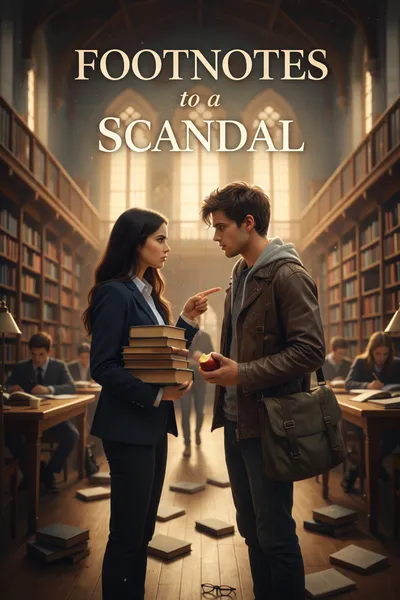
“‘Footnotes to a Scandal,’” he read. “Appropriate.”
My throat tightened. The room felt suddenly too small. “How did you get that?”
“It was in the application pool,” he said, brows drawing together. “You didn’t submit it?”
“Why would I feed more gossip?” My voice came out sharper than I intended. “This campus eats stories like that for breakfast.”
He looked at me—really looked, not the cursory glance-over he’d given me in hallways before—and something uneasy edged into his expression. “Then someone submitted it on your behalf.”
“Neat,” I said, hating how thin my voice sounded. “Anonymity is dead. Long live identity theft.”
He tapped the corner of the printout, thinking. The silence stretched, full of the whirring computer fan and my pulse in my ears.
“When did you write this?” he asked.
“Are you seriously asking me to timestamp my trauma?”
His eyes flicked up, brow furrowing. “I am asking because it is—” He stopped, like admitting what he was going to say would cost him something. “—unusually controlled for an undergraduate.”
Oh.
That was not the word I expected. Not good. Not strong. Not promising.
Controlled.
My hands felt both impossibly far away and too present, every vein buzzing. “So this is the part where you tell me it’s technically competent but morally questionable?”
His mouth quirked—not a smile, exactly. An almost. “You seem very determined to anticipate my reactions. Has that been an effective defense strategy?”
“Sometimes honesty hurts worse than a headline,” I said, before I could stop myself. “Pre-emptive damage control.”
He watched me like I’d just handed him a thesis statement. “I’m not interested in hurting you, Ms. Locke.”
The words landed in the air between us, awkward and heavy. For a second I let myself feel their shape.
Then I snorted. “You have a reputation.”
“Yes,” he said. “For being honest about writing. Not for being unprofessional with students.”
The unspoken hangs there: like the man whose name we never say, whose career quietly relocated to another university while my reputation stayed.
He sat back, steepling his fingers—not quite clichéd, because nothing about him slouched. “This mentorship will last six weeks. If the reassignment is approved, we’ll adjust. In the meantime, we will meet once per week. You will bring new work. I will critique it.”
“Riveting.”
“I don’t care about the rumors,” he added.
A bitter laugh bubbled out of me before I could swallow it. “Everyone cares about the rumors.”
“I don’t,” he repeated, more tightly. “What I care about is whether you are willing to do the work. If not, we can sit here in silence for an hour and both be miserable.”
I opened my mouth to say absolutely not, to tell him where he could file his mentorship alongside the ethics policy. But my gaze slid again to the printed pages of my story, the margins already marked with small, clean notes in his handwriting.
He’d read it. Carefully.
“What did you think?” I asked, trying for flippant and landing somewhere closer to desperate.
He considered, and I realized with a small twist of dread that this was him being kind—choosing his words like they mattered.
“The opening is strong,” he said finally. “The voice is precise. You trust subtext. You don’t explain your metaphors, which is…refreshing.”
I blinked. Compliments from him felt like they should be rationed, like water in a desert.
“But?” I prompted.
He didn’t flinch from it. “You hold the reader at arm’s length. You imply emotional stakes you’re not willing to actually name. It makes the piece feel…guarded. Defensive. As if you expect your audience to weaponize anything you give them.”
My chest tightened. “Maybe because they will.”
“Then the question becomes,” he said quietly, “who is this for? The people who hurt you, or the part of you that wants to be understood?”
Something inside me lurched at the word understood, like a chord struck too hard.
“Wow,” I said, voice dry. “Do all your mentees get free therapy?”
His mouth did that almost-smile again, then straightened. “This is not therapy. It’s craft. You don’t have to answer the question now. But if you’re not interested in pursuing publication, in pushing past this campus and its gossip, then we’re wasting our time.”
“Who says I’m not?” I shot back, stung.
“Your posture,” he said calmly. “And the fact that you keep talking about ‘this campus’ as if you’re already gone.”
I looked down at my hands, realizing I’d folded them so tightly my knuckles were pale. I forced them to loosen, fingers prickling as blood returned.
“Maybe I should be,” I muttered.
He set his pen down. The tiny click sounded louder than it should have. “If you decide to leave, that’s your choice. But if you stay, you’re entitled to more than surviving on the margins of other people’s narratives.”
I hated that the sentence made my throat burn.
“You don’t know anything about my narratives,” I said. “You believed them.”
It slipped out before I could stop it, the accusation sharp and naked.
His eyes widened, just a fraction. Then his gaze flicked away, to the ethics poster, to the window, before returning to me with an effort I could feel from across the desk.
“I made an assumption,” he said slowly. Each word landed like a stone. “I saw a situation I didn’t fully understand and decided the safest course of action was distance. That was a failure of curiosity.”
I stared at him. It was not an apology, not exactly. But it was more admission than anyone else had managed in two years.
“Why are you telling me that?” I asked.
“Because,” he said, holding my gaze now, steady and infuriatingly earnest, “if I’m going to ask you to take risks on the page, it would be hypocritical not to acknowledge my own.”
The air in the office shifted, something tight unspooling between us. For one disorienting second, I saw past the reputation: a man who lived in fear of lines blurred, of careers ruined, of being the headline instead of the byline.
I swallowed. “What happens if the reassignment goes through?”
“Then you’ll be matched with another mentor.” His fingers brushed the edge of my story, an unconscious motion. “But I would still like to see what you write.”
“Purely for the cardio,” I said.
One corner of his mouth lifted. “Something like that.”
Outside, the bell rang, muffled through the thick walls, signaling the end of the period. Students’ voices rose in the hallway, a distant ocean.
He glanced at the clock. “We’re out of time for today. For our next meeting, bring five to seven pages of new work. Any genre. If you don’t have anything, we’ll work from this.” He tapped the printout.
“And if I don’t show up?”
He met my eyes, no flinch this time. “Then I’ll note it with the coordinator.” A beat. “And I’ll assume you’re content letting other people write your story for you.”
It was a cheap shot. It worked.
I rose, my chair scraping softly against the carpet. For a moment we were closer than we’d been all hour, the desk between us suddenly feeling narrower. He stood as well—of course he was tall, because life enjoyed symmetry in its cruelty.
“Ms. Locke,” he said as I reached for the doorknob.
I paused, fingers resting on the cool metal.
“The rumors,” he said. “They don’t factor into my assessment of your work. If you choose to continue.”
I turned just enough to see him over my shoulder. His face was composed, but his hand curled slightly against the desk, like he was bracing for impact.
“Keep telling yourself that,” I said, and opened the door.
The hallway noise rushed in, warm and chaotic and full of eyes. I stepped out into it, the door clicking shut behind me like a punctuation mark.
Halfway down the hall, my phone buzzed.
New email: Mentorship Assignment Update.
I stopped, thumb hovering over the notification. For a moment, I just stood there, caught between the end of one story and the reluctant beginning of another.
Then I tapped it open.